I've been on enough group trips to know how they usually go. Five friends, a WhatsApp group full of "I'll pay, you pay me later," and three months after the trip, someone is still owed ₹4,200 and too awkward to bring it up.
The trip was great. The money part? Not so much.
Most of it I learned the hard way on Goa weekends and Himachal road trips where the money stuff got weird.
Talk about money before you book anything
Nobody wants to be the person who brings up budgets. But someone has to. And doing it early — before anyone books flights or hotels — saves you from the worst version of this conversation, which is the one that happens when someone's already spent ₹15,000 on a resort the rest of the group can't afford.
A simple message works: "Hey, what's everyone comfortable spending for 3 nights? I'm thinking ₹8-10k all-in." That's it. No spreadsheet, no formal meeting. Just get a rough number out there.
If someone wants to spend more, great — that's their call. But the group budget should be something everyone's okay with.
Pick one person to handle bookings
This sounds small but it matters a lot. When three different people are booking hotels, flights, and activities on their own cards, you end up with a tangled mess of who paid what and who owes whom.
Pick one person to be the "treasurer" for the trip. They book the shared stuff — accommodation, rental car, whatever — and everyone else pays them back. It's cleaner. One person, one card, one trail.
Fair warning: the treasurer should be someone who won't lose sleep over fronting ₹30,000 for a few days. If that's a problem, have everyone UPI the estimated amount upfront into a kitty.
Track expenses as they happen, not "later"
"Later" never comes. Or it comes two weeks after the trip when nobody remembers whether the ₹800 at that dhaba was split four ways or five, or whether Priya had already paid for the cab that morning.
Every time someone pays for something the group shares — a meal, fuel, entry tickets, that random round of chai — log it right then. Takes 10 seconds. Pull out your phone, add the expense, move on.
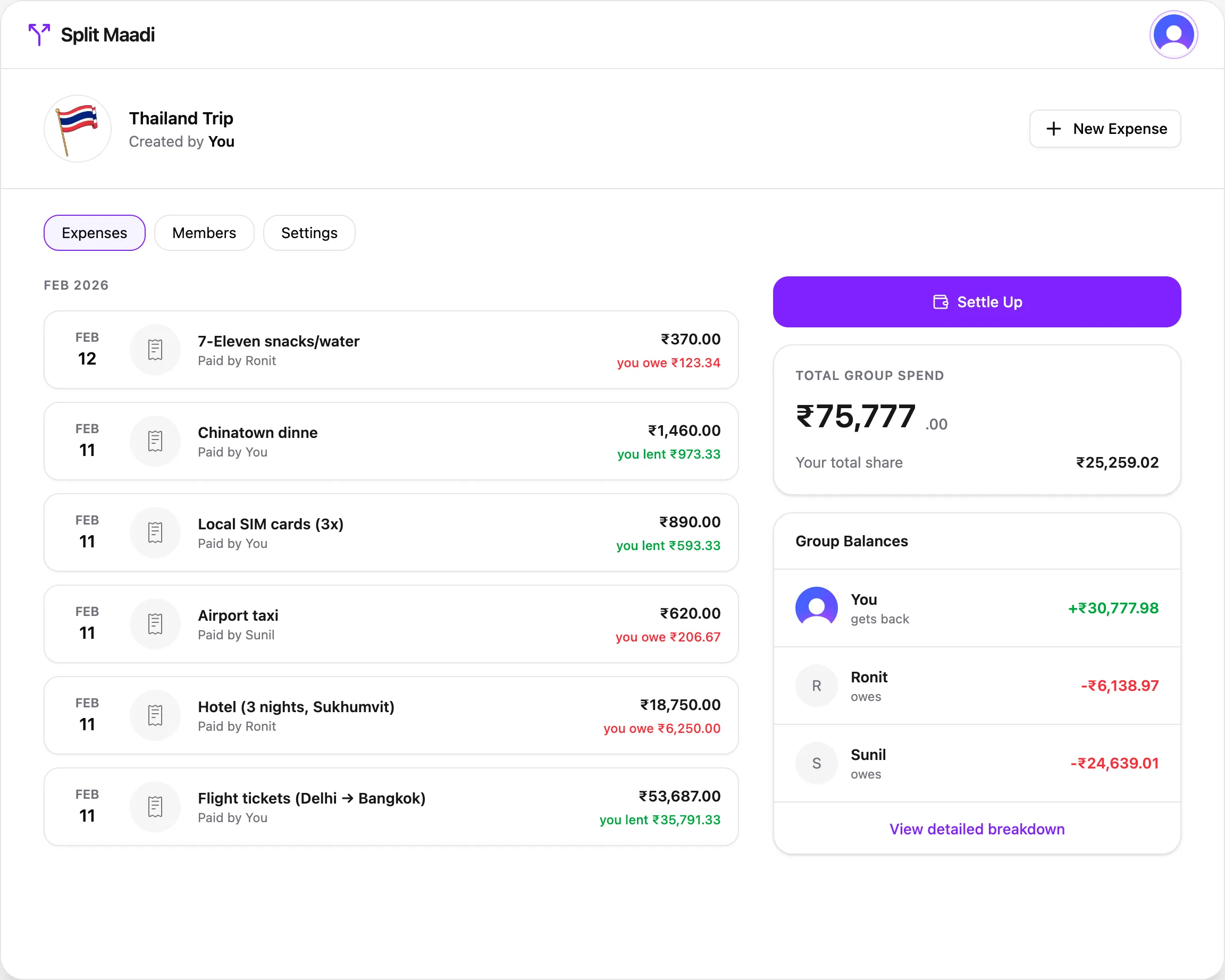
This is where an app like Split Maadi genuinely helps. You create a group, add people, and just keep logging expenses as they happen. Everyone can see the running balance in real time so there are no surprises at the end. You can even snap a photo of the receipt if you want a record.
But honestly, even a shared note on your phone works if you're disciplined about it. The tool matters less than the habit. We compared apps vs spreadsheets in more detail if you're deciding what to use.
Handle the "different budgets" problem head-on
This is the one that ruins trips if you ignore it.
Someone wants to eat at the ₹2,000-per-head seafood place. Someone else is perfectly happy with the ₹200 thali down the road. Both are valid. Neither person should feel bad.
The fix: don't split everything equally by default. Split shared things equally — the hotel room, the cab, the groceries for breakfast. But for meals and activities where people make different choices, split by what people actually had.
If three people go parasailing at ₹1,500 each and two people sit on the beach, don't split the parasailing five ways. This sounds obvious when you write it out, but in the moment, people go along with equal splits to avoid seeming cheap, and then quietly resent it.
When you're using a splitting app, you can just mark who participated in each expense. Problem solved. No awkward conversations needed.
Don't let the "small stuff" pile up
Chai. Water bottles. Auto rides. Individually, none of these matter. But over a 4-day trip, they add up to ₹1,500-2,000 pretty easily. And they're the ones nobody tracks because "it's just ₹40."
Two approaches that work:
One: Ignore truly small stuff. Agree upfront that anything under ₹100 just gets absorbed by whoever paid. This works well if your group is roughly equal spenders.
Two: Track everything. Sounds tedious, but if one person is consistently picking up all the small tabs — the water, the chai, the parking — it adds up, and they notice. Even if they don't say anything.
I prefer tracking everything. It takes a few seconds per expense, and it means nobody's silently keeping score in their head.
Settle up before the trip high wears off
Here's a pattern I've seen too many times: the trip ends, everyone's on a post-vacation high, someone says "let's settle up this weekend," and then... nothing. A week passes. Two weeks. Now it's awkward to bring up. A month later, someone sends a passive-aggressive message in the group chat.
Settle up on the last day of the trip. Or the day after. While everyone still remembers what happened and the group energy is still there. It doesn't need to be complicated — just share the final tally and let people UPI each other.
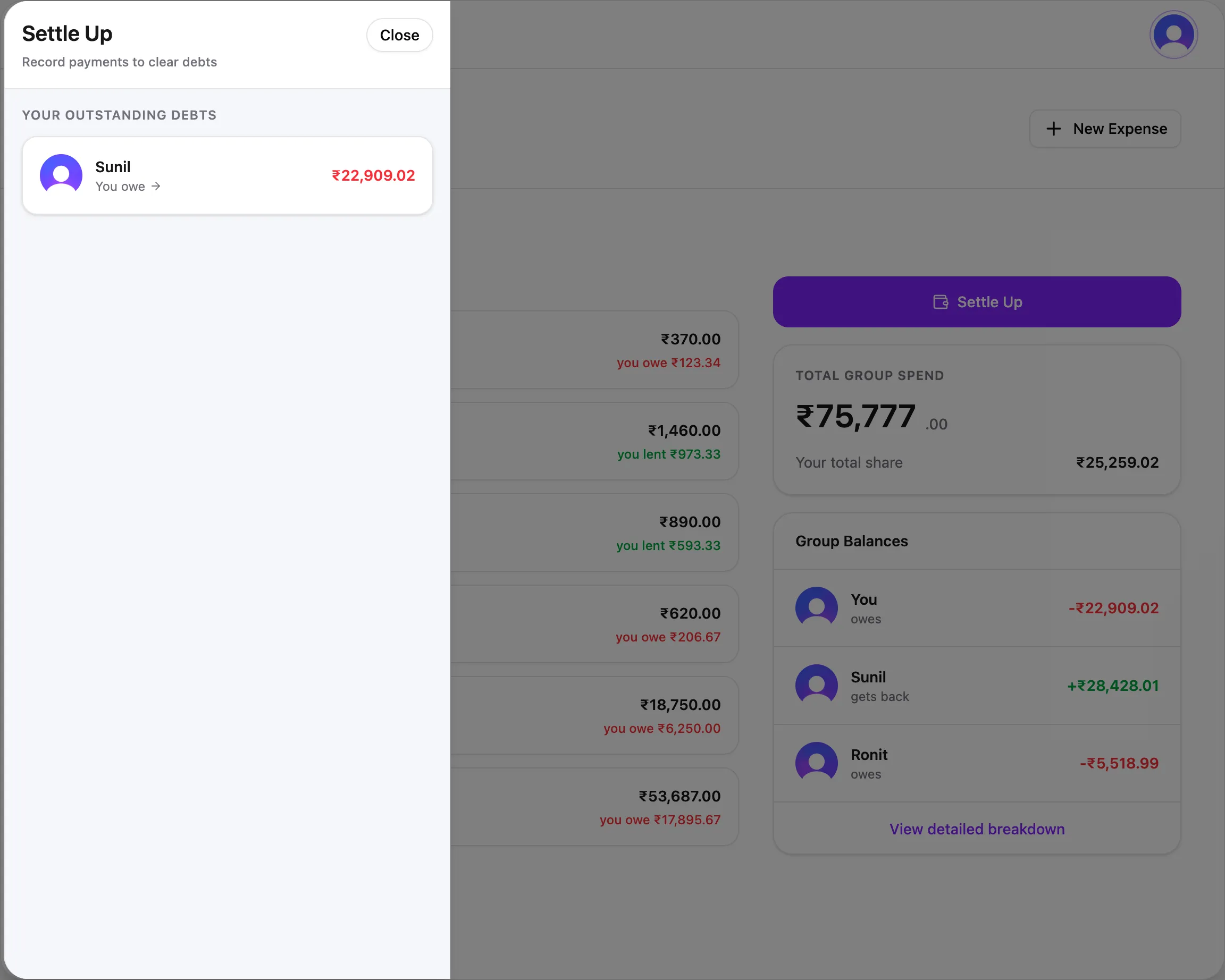
If you've been tracking expenses in Split Maadi, this part is painless. The app calculates simplified debts — instead of everyone paying everyone else, it figures out the minimum number of transactions needed. So instead of 8 separate payments, maybe it's 3.
The awkward stuff nobody talks about
Couples: If a couple shares a room, they should count as two people for the split, not one. Don't make the single people subsidize the couple's room.
The person who "didn't drink": If alcohol is a big expense and someone doesn't drink, don't make them split the bar tab equally. Separate the drinks bill or track it as a different expense.
The early leaver: If someone leaves a day early, they shouldn't pay for the last night's dinner and activities. Adjust accordingly.
The one who never pays: Every group has one. The person who somehow never has their UPI open when the bill comes. The best fix is tracking — when it's all written down, it's hard to hide behind "oh I thought I already paid for something."
What actually matters
The goal isn't to split everything down to the last rupee. It's to make sure nobody feels taken advantage of. Most people are happy to be a little generous — they just don't want to be the only one being generous.
Track things. Be transparent. Settle up quickly. That's really it.
If you're splitting expenses regularly with the same group — like flatmates or a partner — the approach is a bit different from a one-off trip.
The best trip memories are about the sunrise hike and the terrible karaoke night, not about who still owes whom ₹350 for that cab to the airport.