When my friends and I first started tracking shared expenses, we used a Google Sheet. It made perfect sense at the time. We all knew how to use spreadsheets, it was free, and we could customize it exactly how we wanted.
That spreadsheet lasted about three weeks.
The spreadsheet appeal
I get why people reach for spreadsheets first. They're genuinely good for a lot of things.
You have complete control. Want to add a column for who paid, who participated, the category, the date, a note? Go ahead. Want to colour-code expenses by type? Sure. Want to add a formula that tracks running totals per person? Easy enough if you know your way around SUM and VLOOKUP.
They're also transparent. Everyone can see the same data. Nobody's wondering what's happening behind the scenes. The formulas are right there — you can verify the math yourself.
And they're free. No app to install. No account to create. Just a link and a browser.
For two people splitting a handful of recurring bills — say, you and a roommate splitting rent and electricity — a spreadsheet honestly works fine. The expenses are predictable, there aren't many of them, and only two people need to maintain it.
If that's your situation, you probably don't need an app. Keep your spreadsheet.
Where spreadsheets fall apart
But the moment you add more people or more complexity, spreadsheets start breaking.
Nobody updates them. This is the big one. A spreadsheet only works if everyone adds their expenses consistently. In practice, someone forgets. Then they try to remember what they spent three days later and get it wrong. Then someone else stops bothering because "the spreadsheet is never up to date anyway." Within a month, the sheet has gaps, guesses, and stale data.
An app on your phone takes 10 seconds to log an expense. You're at the restaurant, you pay, you log it before you put your phone back. A spreadsheet requires opening a browser, finding the sheet, scrolling to the right row, typing in multiple cells. It's just enough friction that people skip it.
The formulas get wild. For two people splitting everything equally, the math is simple. But what about five people on a trip where different people participated in different expenses? Person A paid for dinner but Person C wasn't there. Person B paid for the cab but it was only for B, D, and E.
To handle this in a spreadsheet, you need a participation matrix — a grid of who was involved in each expense — and formulas that calculate each person's share dynamically. It's doable, but it's genuinely painful to build and almost impossible for a non-spreadsheet person to understand or verify.
I once built one of these. It had 12 columns and nested IF statements. It worked perfectly until someone accidentally deleted a row and the whole thing broke. Nobody knew how to fix it except me, and I was asleep.
Settlement calculation is a nightmare. This is the part most people don't think about until they get there.
After a trip with 6 people, the spreadsheet tells you everyone's total. Great. Now figure out who pays whom.
Without optimization, you could end up with 15 separate transactions. Person A pays Person B ₹200. Person C pays Person A ₹800. Person D pays Person C ₹150. It's chaos.
What you really want is a settlement algorithm that minimizes the number of payments. Instead of 15 transactions, maybe you only need 4. One person pays one other person, done.
Building that in a spreadsheet is technically possible. But you'd need to implement a debt simplification algorithm in Google Sheets formulas. I've never met anyone who's done this successfully. And I've asked.
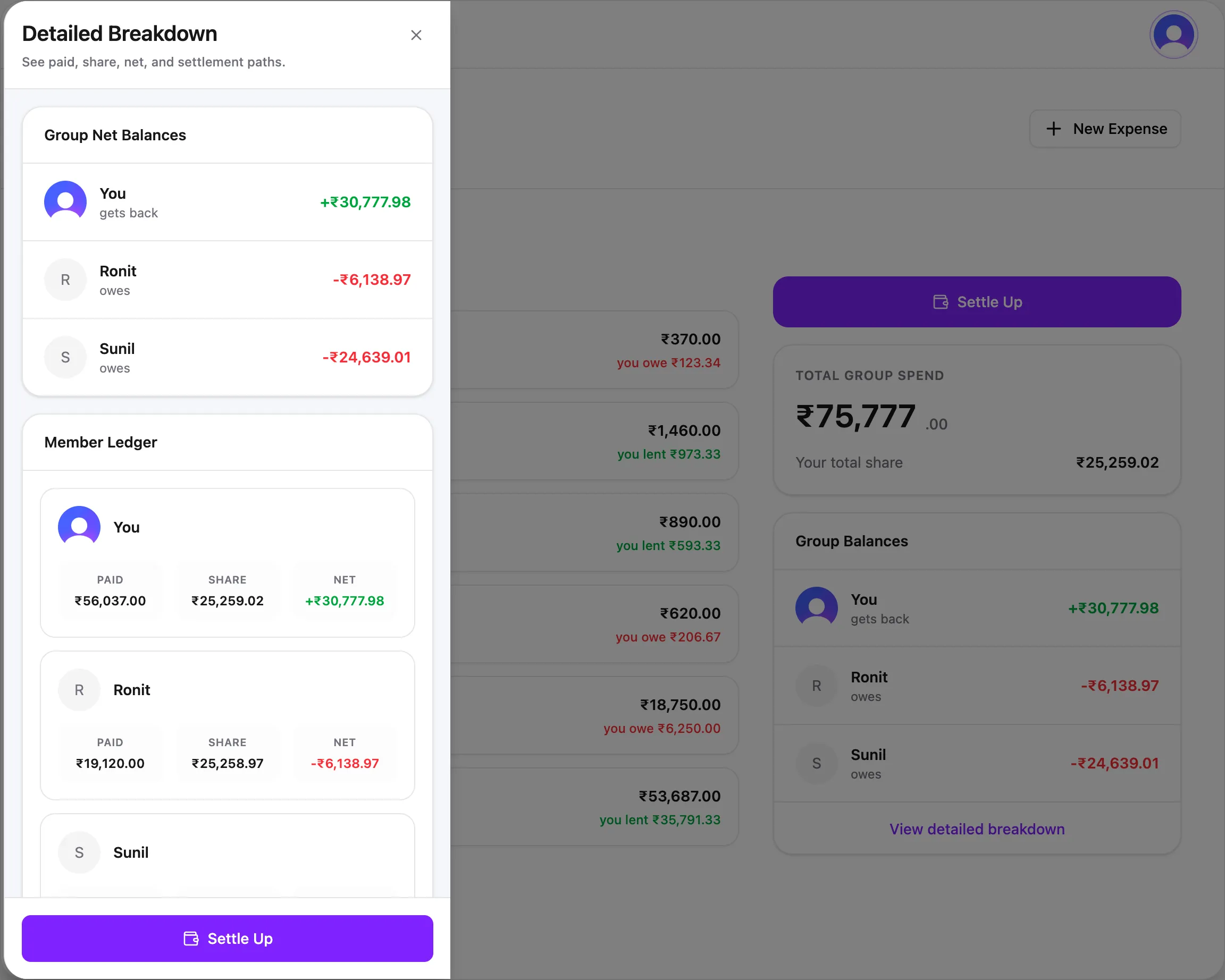
Apps like Split Maadi handle this automatically. You log expenses throughout the trip, and when it's time to settle up, the app tells you exactly who pays whom with the fewest possible transactions. It's the single biggest advantage over a spreadsheet.
No mobile-friendly input. Try adding an expense to a Google Sheet on your phone while standing at a chai stall. The cells are tiny, you're zooming and scrolling, autocorrect is fighting your numbers. It's miserable.
Apps are built for this exact use case — quick expense entry on a phone screen. Name, amount, who paid, who's involved, done.
No notifications or reminders. A spreadsheet sits there passively. It doesn't remind your friend that they owe you ₹3,400. It doesn't ping the group that there are unsettled expenses. It doesn't tell you when someone adds a new entry.
You end up being the human notification system, which nobody enjoys.
The honest comparison
Honestly, both have their place:
If you're two people splitting predictable bills — rent, electricity, WiFi — a spreadsheet is genuinely fine. You don't need settlement optimization for two people, and the discipline required is minimal.
The moment you hit three or more people, or the expenses get irregular — trips, dinners, events where different people participate in different things — spreadsheets become painful fast. That's where an app earns its keep. Not because it's fancier, but because it removes the one person who has to maintain everything.
For the roommate scenario specifically, we put together a practical guide to splitting bills with flatmates.
That last point matters more than you'd think. In every group that uses a spreadsheet, there's one person who built it, maintains it, and fixes it when things break. Everyone else just adds data (sometimes). When that person gets tired of being the bookkeeper, the whole system collapses.
With an app, there's no single point of failure. Everyone logs their own expenses. The math is automatic. Nobody needs to maintain anything.
What about Splitwise?
Fair question. Splitwise has been the go-to for years. It works well. But it's also increasingly pushy about its paid tier — limiting the number of expenses you can add, putting features behind a paywall.
Split Maadi handles group expenses, unequal splits, settlement optimization, and multiple currency options — and it's genuinely free. No limits, no "upgrade to pro" nudges. It works on the web, iOS, and Android. You can share invite links or QR codes to add people to groups.
I'm biased, obviously, since I'm writing on the Split Maadi blog. But I switched from Splitwise after hitting the free tier limits one too many times, and I haven't looked back.
We did a more detailed comparison with Splitwise if you want the full breakdown.
The bottom line
If you're splitting rent with one roommate and you enjoy spreadsheets, keep doing what you're doing. Seriously. It works.
But if you're tracking expenses for a group trip, a friend circle that eats out together, or a household with three or more people — just use an app. The 30 seconds you save per expense adds up, the automatic settlement saves you from uncomfortable mental math, and nobody has to be the designated spreadsheet maintainer.
Your time is better spent arguing about where to eat dinner than about who paid for it last time.