The "Who Paid for What" Conversation
You moved in together. Congratulations. Now you're having a new kind of argument — the one about money that isn't really about money.
"I paid for groceries last week." "Yeah, but I paid for dinner on Saturday." "That was ₹1,200, groceries were ₹3,800." "Fine, but I also paid the wifi bill." "When?" "Last month." "That was two months ago."
Nobody's being unreasonable here. You both just have incomplete information and decent memories that contradict each other. This is fixable.
Why Couples Track Expenses Differently
Flatmates split rent. Friends split dinner. Couples are different because the expenses are constant, overlapping, and often unequal on purpose.
Maybe Nikhil earns ₹1.2L and Ananya earns ₹80K. Splitting rent 50/50 on a ₹30,000 apartment means she's spending 19% of her salary on rent while he spends 12.5%. A lot of couples decide that's not fair and go 60/40 or proportional to income.
But then groceries are 50/50. And eating out depends on who suggested the place. And that ₹8,000 coffee table from Ikea — was that a shared purchase or did Ananya just want it?
This is where tracking helps. Not to be petty. To avoid the slow buildup of resentment that comes from feeling like you're always paying more.
Setting Up a Couples Group
Create a group on Split Maadi with just the two of you. Call it whatever you want — "Home," "Us," "The Damage" — it doesn't matter.
The setup takes one minute. Share the invite link, or just show them the QR code on your phone. They scan it, they're in. No app download needed.
Percentage Splits for Rent
Agreed on 60/40 for rent because of the salary difference? Set up the expense with a percentage split. Nikhil pays the ₹30,000 to the landlord, adds it to Split Maadi, sets it as 60% him and 40% Ananya. The app calculates that she owes ₹12,000. Clean.
Next month, same thing. The split ratio stays consistent, and there's no conversation needed about "your share this month."
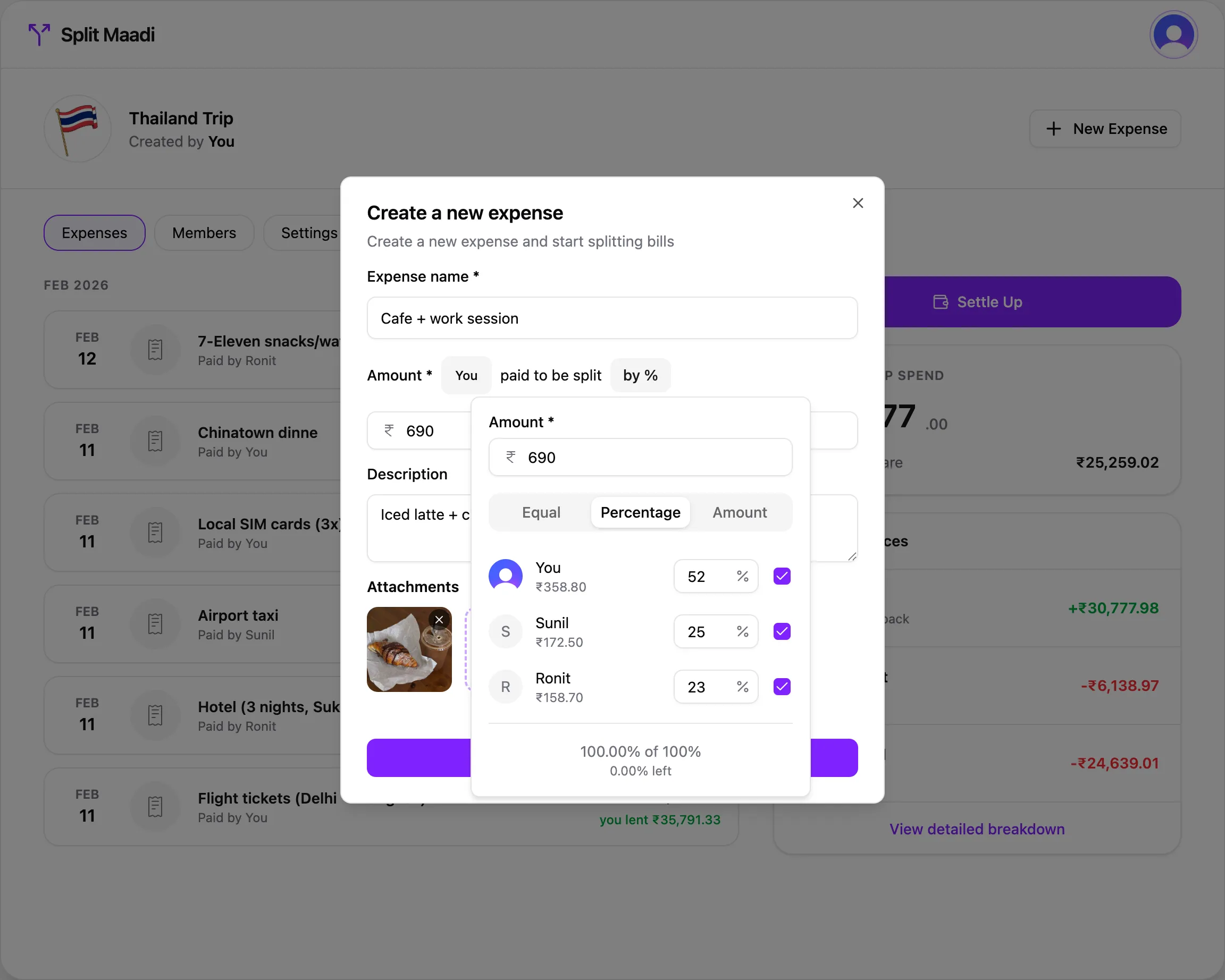
Equal Splits for Shared Stuff
Groceries, cleaning supplies, the gas cylinder, the Swiggy order on a lazy Sunday — these are usually 50/50. Add them as equal splits. Two taps.
Over the course of a month, you might add fifteen or twenty small expenses like this. Individually they don't matter much. But they add up to ₹8,000-₹12,000, and it's worth knowing if one person has been covering most of it.
Skip the Personal Stuff
Ananya's gym membership isn't a shared expense. Nikhil's PlayStation subscription isn't either. Don't add those.
The group should only have expenses you've both agreed are shared. Keep personal spending personal. This boundary actually makes the system work — it prevents the "well I spent ₹5,000 on my thing so you should spend ₹5,000 on yours" comparison game.
Settling Up Without the Awkwardness
This is the part that stops most couples from tracking expenses: nobody wants to send their partner a Splitwise reminder that says "You owe ₹4,300."
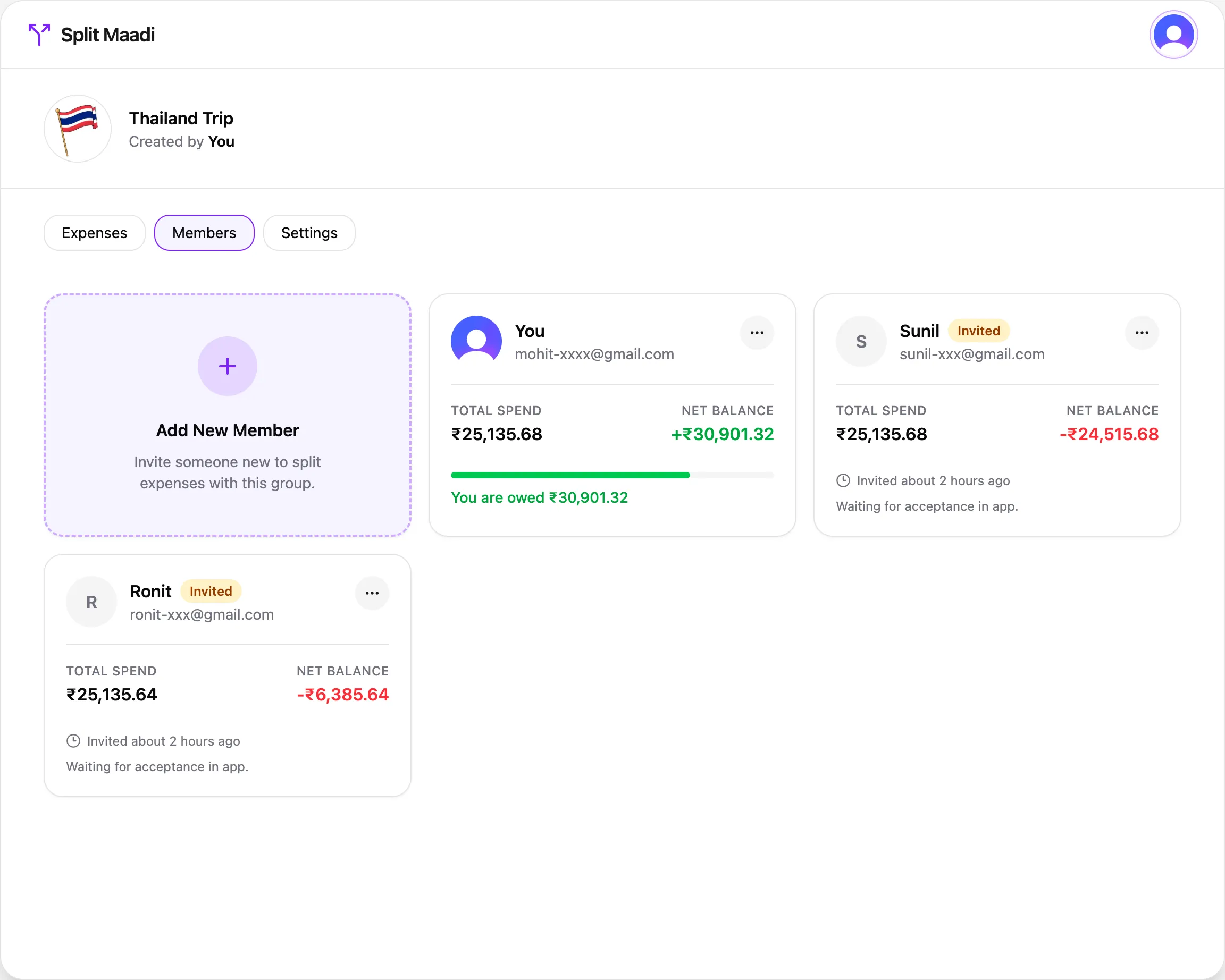
Split Maadi doesn't send automated reminders or passive-aggressive notifications. The balances are just there, visible to both of you. You settle up when it makes sense — maybe at the end of the month, maybe when the balance crosses ₹5,000, maybe whenever.
Some couples settle every month like clockwork. Others let it run and settle up every quarter. One couple I know only settles when someone's balance crosses ₹10,000. There's no wrong way to do it.
The point isn't the settlement. The point is that both people can see the same numbers, so there's no "I feel like I'm paying for everything" simmering in the background.
The Real Benefit: Fewer Arguments
Financial disagreements are consistently the biggest source of conflict in relationships. Not because anyone is being greedy, but because most couples don't have visibility into their shared spending.
When you track expenses together, a few things happen:
You stop keeping a mental tally. The app does it for you, and it's more accurate than your memory.
You stop feeling like you need to "catch up" after your partner pays for something big. The balance adjusts automatically.
You can actually talk about spending patterns with real data instead of vibes. "We spent ₹22,000 on eating out this month" is a conversation starter. "I feel like we eat out too much" is an argument starter.
It's Not About Being Petty
Some people hear "couples expense tracker" and think it sounds transactional. That tracking every ₹200 Swiggy order is penny-pinching.
It's the opposite. When you don't track, small imbalances pile up silently until someone snaps. When you do track, the small stuff stays small. A ₹200 difference is just a ₹200 difference — it gets absorbed into next month's balance. Nobody stews over it because it's visible and accounted for.
Turns out, the couples who actually track this stuff fight about money way less. Not because they care less — because there's nothing to guess about.
Track shared expenses without the awkwardness
Just a shared group for you two. Free forever, no strings.
Try Split Maadi freeWorks for Any Arrangement
Living together, dating but separate apartments, married with a joint account for some things and individual accounts for others — Split Maadi works for all of it. Track what you want to track, ignore what you don't.
If you're also splitting costs with flatmates or a group of friends, you can keep separate groups for each.
Free. No limits. No awkward premium tier that one person has to pay for. Just a shared space to log your expenses and keep things clear.